
PARENTS · PRIVATE SCHOOLS · ESSAY
The 66% Gap: What Parents Really Mean When They Say School Isn't Working
Two-thirds of parents say school isn't working for their child. They're not talking about test scores. They're pointing at the one thing even the best private schools can't seem to deliver.

Tirzah Elese Bagnulo
Founder & CEO, ExelAcademy · 11 min read

In my last post, I made the case that school isn't failing. It's succeeding at precisely what it was designed to do, and what it was designed to do is not what your child actually needs.
Which raises an obvious question. If the public system is a factory, can money buy your way out of it?
Talk to parents who have tried, and you hear versions of the same few lines. You may recognise yourself in one of them:
"I moved my kids to private school and I still feel this."
"We homeschool, and the curriculum we bought is basically the factory, just at my kitchen table."
"My daughter is a straight-A student at one of the top schools in the country. She can't start a conversation with an adult."
The pattern is the same whether you're in Manhattan, Los Angeles, London, Zurich or Singapore. Parents who have spent years and significant money on the premium version of school are quietly watching the same gap open up in their own homes.
And in the UK, the question just got louder. The government added 20% VAT to private school fees from 1 January 2025, pushing the cost of a full independent education towards £500,000 per child. In the first year, around 13,000 pupils left UK independent schools, and 21% of parents say they're considering moving their child to a cheaper school. Families are being forced to ask what many had been avoiding: if we're paying even more for the same model, is the model itself worth it?
"School Isn't Working": What It Actually Means
A UK survey of 2,000 parents found 66% believe the current model doesn't work for their child. In a separate Tyton Partners study, 50% of parents said they want student-centred education: a model built around the individual child, not the standardised group. And Gallup's student data shows engagement peaks around fifth grade and declines every year after.
Once you listen closely, what these parents are describing is not a curriculum problem. It's not a teacher problem. It's not even a school-quality problem. It's structural.
Strip away the polite language and they are saying, with striking consistency, some version of this:
"My child is not becoming a capable adult."
Not "my child isn't learning the material." The material is mostly fine. The grades are mostly fine. The school photo is impressive.
The concern is deeper and harder to name. It is the quiet suspicion that after thirteen to fifteen years, perhaps $500,000 in a private system, and endless logistical effort, the young person walking across the stage at graduation is not ready to author their own life. And the parents who have worked hardest to pay for the best option are often the ones who feel this most.
Here are the six gaps they are pointing at, and why they exist even in the most expensive schools in America and the UK.
Gap 1: Agency
The number one thing high-achieving parents quietly say about their own children: they wait to be told what to do.
They are brilliant responders. Excellent optimisers. Hand them a rubric and they will crush it. Hand them a blank page with no rubric ("go and do something valuable with the next three months") and something goes wrong. They freeze. They ask clarifying questions that are really requests for permission. They check in constantly. They can't start.
This is not a character flaw. It is the successful output of thirteen years in a system built around external direction. Every hour of the school day, from age 5 to 18, someone else defines the task. The reward system trains you to do what is assigned, not what matters.
Even the most progressive private schools can't solve this with an elective or a capstone project. Agency is not a class. It's a default mode. You either build it into the operating system of the day, or you don't.
Gap 2: Real-World Capability
Your 16-year-old can write a five-paragraph analysis of Jane Eyre. But can they:
- Negotiate a price, run a meeting, or read a lease?
- Fix a toilet, or make a meal for ten?
- Launch a product, close a sale, or ship a piece of code?
- Cold-email a stranger and get a reply?
- Interview someone for an hour and leave with a clear story?
Almost certainly not. Not because they're incapable, but because school doesn't teach any of these things, even elite school. Partly because they can't be graded on a standardised test, and partly because of liability. Practical skills were steadily stripped out of American schools between 1970 and 2000: home economics enrolment has fallen by around 38% from its peak, and shop class has disappeared from a large share of US high schools.
Wealthy families on both sides of the Atlantic often paper over this gap with summer camps, gap years, volunteer trips and internships. Those help. But a summer is not a training regime. A one-off internship doesn't build compound capability. Real-world skill has to be part of the weekly structure of a child's life, not bolted on when school is out.
Gap 3: Taste
Taste is the skill of telling good from bad without a rubric. In the AI era it may be the most valuable capability of all, because almost everything else can be generated on demand. Judgement about what's worth making, buying, reading, funding or hiring: that's what is scarce.
Schools wear taste down. Not intentionally. Structurally. Grading requires measurable criteria, and measurable criteria reward conformity to a standard. A child who writes a strange, original, imperfect essay will lose to a child who writes a rubric-perfect, unoriginal one, every single time. Thirteen years of that, and they stop making anything strange. They stop making anything, really, unless someone is going to grade it.
You don't build taste inside a grading system. You build it by putting things into the world, getting real reactions, iterating, and developing judgement about what works.
Gap 4: Skin in the Game
Every high-agency adult you know shares one trait: they have done something real where the outcome actually mattered. They built something someone paid for. They made something someone used. They said something in public and lived with the reaction.
This may be the single most important experience a young person can have before adulthood. And school, any school, at any fee level, systematically prevents it. The audience is one teacher. The outcome is a letter. The cost of failure is nothing that matters. After thirteen years, many young people genuinely can't tell the difference between something that mattered and something that was graded.
Gap 5: Mentors Who Do the Actual Thing
Your child will spend around 13,000 hours with teachers. As a teacher myself, I know how much good those hours can do. But most teachers have never run a company, raised capital, launched a product or negotiated a deal. That is not a criticism. It is a job description. Teachers teach. Operators operate. They are rarely the same people.
At elite schools, children occasionally brush against high-achieving adults through alumni networks or a guest speaker. That is not mentorship. Mentorship is sustained and personal, and it needs the adult to be part of the young person's weekly life. The institutional model, the calendar and the legal structure of most schools don't make room for it. It has to be designed in from the beginning.
Gap 6: Knowing Themselves
The last gap is the deepest. Ask a typical 17-year-old at a top school what they actually care about, what they actually want, what they're actually good at, what they'd do if no one was watching. Most can't answer. They have spent thirteen years optimising for other people's assessments. They don't know themselves because they've never had the space to find out.
The external scaffolding is perfect. The internal structure was never built.
None of These Are Curriculum Problems
Notice what all six gaps have in common: none of them can be fixed by adding a class.
They are architectural. They are shaped by the structure of the child's day, the nature of the work they do, the adults they spend time with, and whether their outcomes are real. That is why even the best-funded, best-intentioned private schools can't close them. The 1843 blueprint was never designed to produce agency, capability, taste, skin in the game, mentorship or self-knowledge. You can't patch those into a factory. You have to build a different machine.
If the factory isn't going to produce what my child needs, and the premium factory isn't either, what am I actually going to do about it?
What ExelAcademy Is Designed to Build
We designed ExelAcademy around these six gaps from the very first day.
- Agency is the operating system. Learners help shape their own path, choose their ExelQuests™ and set their pace, with adults as guides rather than directors. It feels uncomfortable at first. Then it becomes who they are.
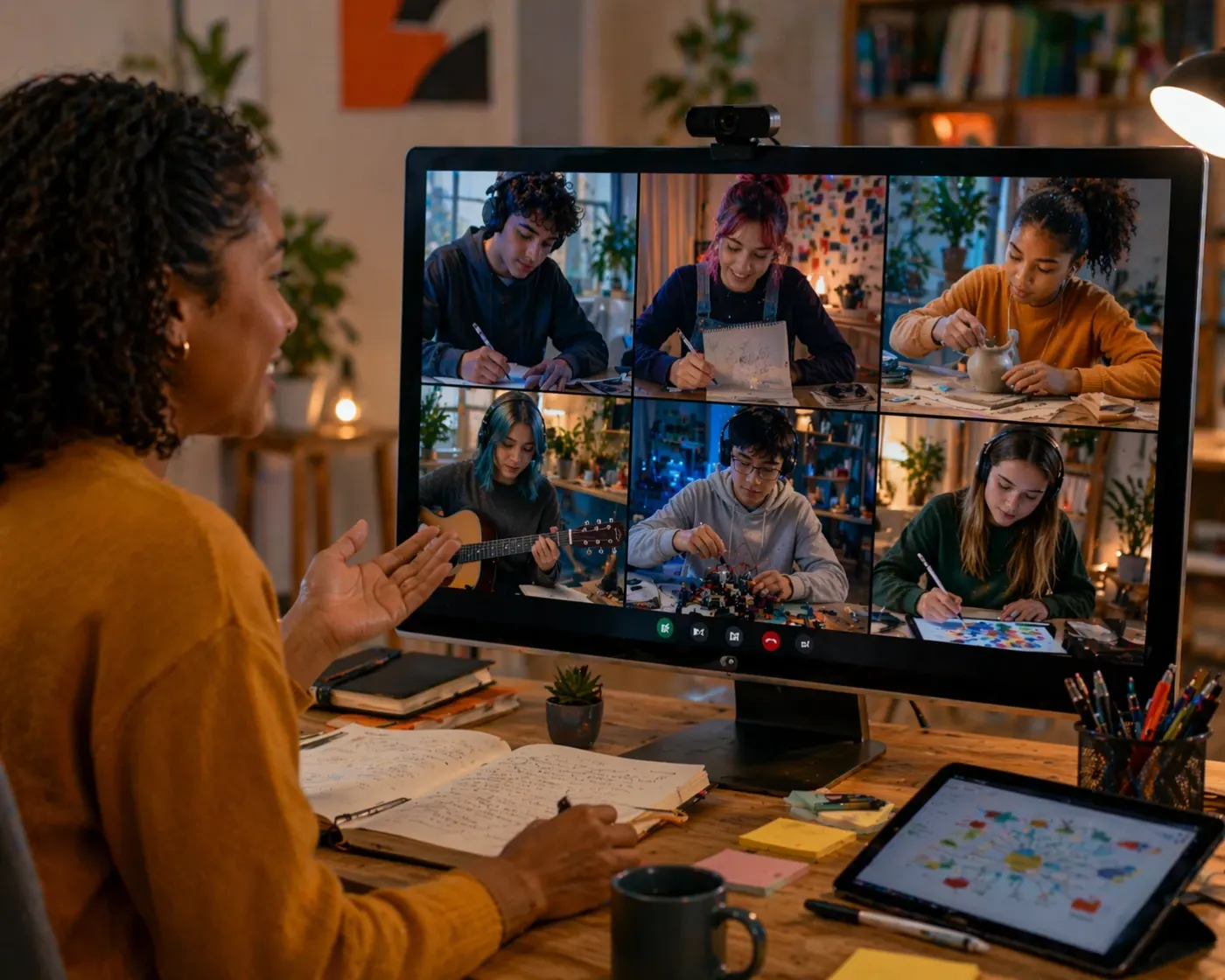
- Real-world capability is the curriculum. Around 80% of learning happens through ExelQuests™: real challenges that ask young people to build, pitch, fix, cook, negotiate, code, write or teach, always with a real outcome.
- Taste is developed by making. ExelQuests™ are designed to produce something seen, used or judged by someone outside the school. Young people learn to tell good work from bad the way humans always have: by making things and seeing what happens.
- Skin in the game is built in. Every major Quest has a real audience and a real outcome. Some will succeed. Some will fall short, visibly. All of them teach what it feels like to do something that counts.
- Mentorship is part of the design. We are building a network of mentors (founders, builders, creatives, tradespeople and leaders) to work alongside our learners as part of their regular rhythm, not as a one-off guest appearance.
- Self-knowledge follows. When a young person is trusted, given real work, and allowed to succeed and fail for years on end, they come to know who they are. That is the most valuable thing we can hand them.
Imagine a 14-year-old who has already run a small food business for a month, built an app her family actually uses, and taught a skill to a real audience. She is not missing real-world capability. She is the one you would want to hire.
These are not features. They are the whole point.
The Choice the 66% Are Facing
If you're among the two-thirds of parents who feel the gap, especially if you've already paid for the premium version of the factory and still feel it, the conclusion becomes clear quite quickly.
You are not looking for a better school.
You are looking for a different kind of school, built for a different kind of outcome: a young adult who can author their own life, make their own judgements, build their own things, know their own mind, and walk into the world with agency, taste and skin in the game.
The factory was built for a world your children will not live in. You know it. They deserve a school built for the one they will.
About Tirzah
Tirzah Elese Bagnulo is Founder and CEO of ExelAcademy, a human-led, AI-enabled online school. She brings more than three decades of teaching and educational transformation, fifteen years of studying how the brain learns, and is the author of The Learning Commitment. Tirzah Talks is where she thinks out loud about what education is for, now that AI can do so much of what it once focused on.
Sources & further reading (9)+
- Sustain Health Magazine. Why Parents Say the Education System Is Broken (UK 2,000-parent survey, 66% figure).
- Tyton Partners. Parent demand for student-centred education.
- Gallup Student Poll. Engagement declines by grade.
- GOV.UK. Applying VAT to private school fees (policy document).
- Institute for Fiscal Studies. Tax, private school fees and state school spending.
- Schools Week. Private school VAT raids: what's the actual impact? (13,000 pupils; 21% considering a move).
- Weatherbys Bank. Cost of UK private schooling approaching £500,000 per child.
- Hechinger Report. Home economics: a vanishing subject (38% decline).
- EdWeek. The Decline of Career and Technical Education (shop class cuts).


More Tirzah Talks
Find more blogs in Tirzah's Homeschool Network
Join the community for new Tirzah Talks posts, ready-to-use project-based learning, and a place to share your thoughts with families who believe education can be better.