
ACCREDITATION · ESSAY
Not More Conventional. More Demonstrable.
What our accreditation taught us about doing education differently, and why innovation has to earn its trust.

Tirzah Elese Bagnulo
Founder & CEO, ExelAcademy · 5 min read
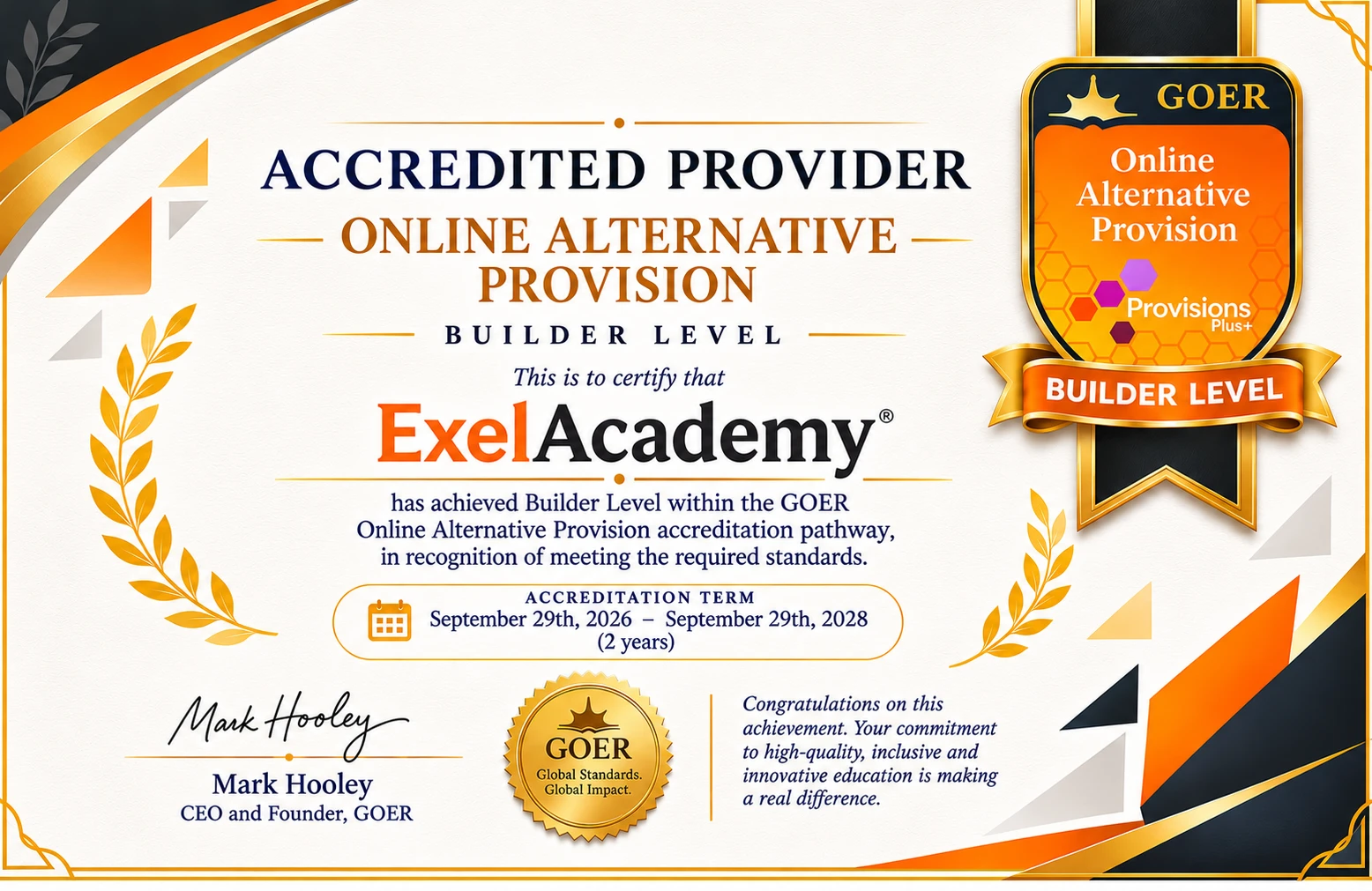
Our final accreditation report has landed. GOER and Provisions Plus+ reviewed ExelAcademy on the Online Alternative Provision pathway. For twenty-five years I sat on the other side of reports like this one, as a teacher, at the Department for Education and in Local Authority leadership. This time I read it as the one being judged.
One sentence stopped me:
“The objective is not to make Exel Academy more conventional; it is to make its distinctive model more demonstrably safe, effective and sustainable.”
That sentence is the whole argument for education reform. Reform doesn’t mean less rigour. It means rigour that fits what’s being built. It doesn’t mean escaping accountability either. It means earning it on new terms.
What it really takes to do education differently
Everyone agrees education has to change. Almost nobody talks about the friction.
Our accountability systems were built to inspect timetables, classrooms and lesson plans. So what happens when a model redesigns how learning is organised, rather than putting the old timetable online? The reviewers named this tension directly. Because ExelAcademy is a redesign, they said, the framework has to test whether the innovation has controls around it that are just as clear.
Innovators usually fall into one of two traps. Some treat accountability as the enemy and wave it away. Others bend until their model looks like everything it set out to replace. Both let young people down.
The third way is harder. You keep the vision and prove it. The report puts it plainly: our design is ahead of our evidence, and writing more policy won’t close that gap. Only practice will.
So here’s a question worth sitting with. How many schools could follow one young person’s journey from the day they arrived to where they ended up, and show what changed along the way? That’s the standard the reviewers have set for us. Maybe it should be the standard for everyone.
What the reviewers praised
The reviewers found real strengths, and they named them without hedging.
ExelTutors and ExelQuests were recognised as a coherent design, not a pile of disconnected online activities. The reviewers also highlighted:
- Relationships first. Our relational, trauma-aware and neurodiversity-informed approach. They said support is built into learning, not bolted on beside it.
- Safety by design. Safeguarding was judged comparatively strong in its design, including how we handle the risks specific to learning online.
- Honest leadership. We had named our own risks before they did. They called that a positive sign of organisational self-awareness.
Human-led, AI-enabled: what the reviewers said
The reviewers didn’t flag AI as a risk to be contained. They said our principle is “well aligned” with what young people need to be safe online. That principle is that technology should extend human potential without replacing human purpose, care or judgement.
Then they pushed us further, and rightly so. A principle has to be visible in practice:
- AI can assist with planning, spotting patterns, personalisation and admin.
- A named human decides anything high-stakes: safety, suitability, assessment, support and placement.
- The record shows it. Anyone looking should be able to see where a human reviewed a decision and how a concern was escalated.
- A trusted adult is always within reach. Every learner should be able to reach a real person easily and raise a worry privately.
That’s the line we’ve drawn from the start.
AI is the tool. The relationship is the point.
What we’re working on
We were assessed at Builder Level while we build and grow our student base. The reviewers were clear about what that means. It reflects the stage of evidence available, not “an absence of strong practice or potential.” The design is in place. The next layer of proof comes from young people learning in it, and that evidence grows with every learner who joins us.
So here’s what comes next:
- Grow carefully and do it properly. Steady, well-supported cohorts, not a rush to scale.
- One learner, one story. Every young person’s journey will be traceable, from why they joined to what they learned to where they went next.
- Attendance as care, not compliance. Knowing who’s present is how we notice who’s struggling.
- Voices that change things. Feedback from learners and families will be tied to the decisions it led to.
- Follow them forward. We’ll track where young people go three, six and twelve months after they leave us.
- Publish the honest version. That means what worked, what didn’t and what we changed.
- Grow only with fidelity. We’ll agree a set of non-negotiables before any partner delivers ExelAcademy.
The real test
We don’t want to be exempt from scrutiny. We want scrutiny that can see what we’re building, and we want to meet it.
That’s the conversation education needs to have. The question isn’t “should we innovate?” or “should we be held to account?” It’s how we do both at once without losing what makes the new thing worth building.
About Tirzah
Tirzah Elese Bagnulo is Founder and CEO of ExelAcademy, a human-led, AI-enabled online school. She brings more than three decades of teaching and educational transformation, fifteen years of studying how the brain learns, and is the author of The Learning Commitment. Tirzah Talks is where she thinks out loud about what education is for, now that AI can do so much of what it once focused on.
Sources & further reading (1)+
- GOER and Provisions Plus+. Exel Academy, Online Alternative Provision: Final Accreditation Report (September 2026). All quotations in this post are taken from this report.
More from Tirzah Talks


More Tirzah Talks
Find more blogs in Tirzah's Homeschool Network
Join the community for new Tirzah Talks posts, ready-to-use project-based learning, and a place to share your thoughts with families who believe education can be better.