
AI & LEARNING · ESSAY
Beyond Recall
Why the future of learning cannot look like even a previous 'Outstanding' lesson, and what we are building instead.

Tirzah Elese Bagnulo
Founder & CEO, ExelAcademy · 9 min read
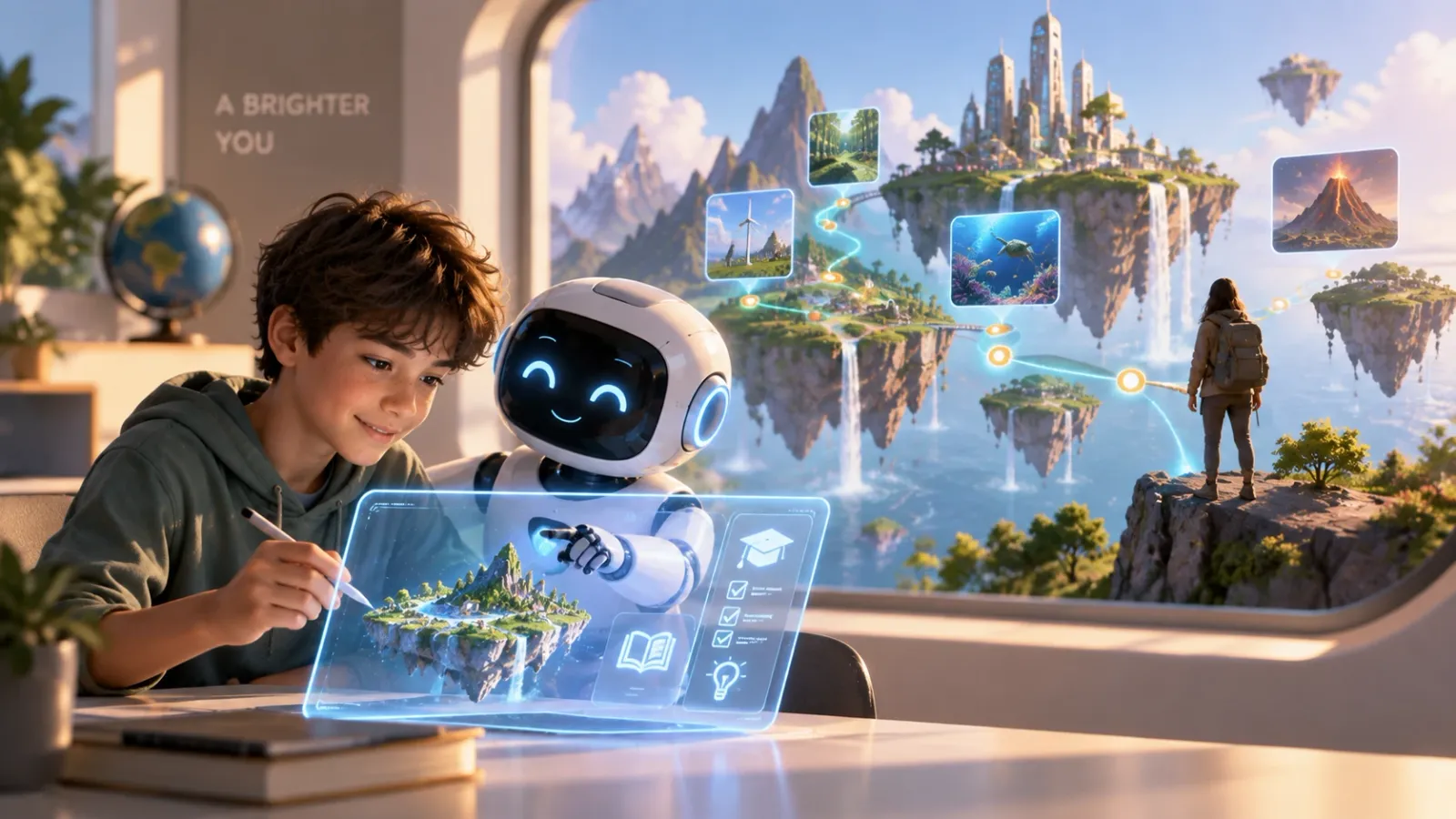
Let's start with a question that most schools are still too frightened to ask.
If an AI system can now generate, retrieve, analyse and synthesise knowledge faster than any human being alive, what exactly is school for?
Not as a provocation. As a genuine, urgent, civilisation-level question.
Because right now, classrooms across the UK and the US are still asking children to memorise things, sit still, reproduce answers on command, and be assessed against standardised benchmarks that were largely designed in the early twentieth century, for a world of factories, filing clerks and industrial obedience.
Inspectors are still walking into classrooms, or reviewing AI learning tools, and measuring what they find against a definition of "outstanding" that was written before everyone carried a smartphone. Before social media. Before generative AI. Before the world your child is actually growing up in.
There are aspects of great teaching that are timeless. Curiosity. Challenge. The refusal to let thinking stand still. The belief that every learner can go deeper. Explicit clarity about learning intentions and what success looks like. These things do not expire.
But the frameworks built around them, and the theories they come from (the lesson structures, the assessment criteria, the pedagogical rulebooks) were written to deliver a better version of a long-standing traditional system. Is that still the quality we are looking for?
It is not enough to take what worked in 2000 and deliver it faster, digitise it or make it more efficient. The world has shifted too fundamentally for that. We need to take every assumption about what good learning looks like and put it through its paces again: honestly, rigorously and without sentimentality. To find out what still holds, what needs reimagining, and what we need the courage to leave behind entirely.
That is not a comfortable process. But it is the only responsible one. Because while we hesitate, the most powerful intelligence tools in human history are already sitting in our children's pockets.
Something has to change. Not eventually. Now.
"The illiterate of the 21st century will not be those who cannot read and write, but those who cannot learn, unlearn, and relearn."
Alvin Toffler, Future Shock (quoting psychologist Herbert Gerjuoy)
The World Has Changed. Education Has Not.
Yuval Noah Harari, in Nexus, describes humanity as entering a period in which the control of information and narrative will shape civilisation more profoundly than industrial production ever did. AI, he argues, is not simply another technological tool. It is a civilisational shift that will fundamentally alter the relationship between human beings, knowledge and power.
Mo Gawdat, former Chief Business Officer at Google X and author of Scary Smart, puts it even more plainly. AI, he warns, will not simply be fitted into the world we live in. It will reshape the world itself. The question that matters is not how we use AI, but who we need to become alongside it.
Sam Altman, CEO of OpenAI, has spoken openly about AI dramatically restructuring labour markets, redefining productivity, and changing what it means to contribute meaningfully to society. Demis Hassabis, co-founder and CEO of Google DeepMind, has described AI as one of the most transformative scientific developments in human history.
These are not fringe voices. These are the people building the tools. And they are telling us, loudly and clearly, that the skills that made the last generation successful will not be enough for the next one.
Education has not listened.
EXELACADEMY PEDAGOGICAL FRAMEWORK, 2026
"Cognitive science from the 1980s to the 2000s remains critically important. But it is insufficient on its own for preparing learners in a world where information is infinite, synthetic cognition is accelerating, and human value increasingly lies beyond procedural recall."
What AI Can Do, and What Only Humans Can
Here is the honest reality of where we are.
AI systems can now retrieve almost any piece of information within seconds. They can synthesise knowledge across disciplines, generate sophisticated written analysis, write code, produce research summaries and create media. For the first time in human history, intelligence is no longer exclusively biological.
Which means the educational challenge is no longer "How do we help learners remember information?"
The challenge is now: "How do we prepare human beings to think, create, adapt, collaborate and remain meaningfully human in an AI-shaped world?"
The future will not mainly reward people for memorisation, procedural repetition or standardised output. AI already outperforms us in those domains. The emerging value of human thinking lies somewhere else entirely.
It lies in judgement. In interpretation. In ethical reasoning. In creativity and emotional intelligence. In the ability to ask the right question, not just retrieve the right answer. In connecting ideas across disciplines. In adaptability, wisdom and human connection. In entrepreneurial thinking, and the courage to build something from nothing. In the skill to analyse information, judge whether it is true, challenge it, extend it and make it your own. In knowing why, what for, and how to use what we know to build a more human world.
These are not soft skills. They are the hard skills of the future economy. And they cannot be produced by a curriculum built around compliance and recall.
AI on its own will neither save us nor destroy us. That depends on what we build with it, and on who we teach our children to become. Designed well, it can give us back something precious: more time to live, think and connect as humans.
The Danger We're Not Talking About: Cognitive Passivity
There is a huge amount of public conversation about AI making children lazy, making learning too easy, or replacing human teachers.
These are real concerns. But they are not the deepest one.
The deepest concern is this: as AI becomes ever more capable of generating answers instantly, there is a growing risk that learners stop thinking altogether. That they become passive consumers of machine output, handing over reasoning, analysis and meaning-making, and losing the cognitive muscles that make them human in the process.
Emerging research on "cognitive offloading" already raises serious questions about what happens to human reasoning when digital systems do our thinking for us. So the educational challenge is not simply "How do we make learning faster?" It must also be: "How do we protect deep human thinking in a world increasingly shaped by machine intelligence?"
This is not a problem traditional schooling is even asking about. And it is certainly not one that endless worksheets, standardised tests and compliance-based assessment will solve.
The goal is not to eliminate human thought. The goal is to elevate it.
What ExelAcademy Is Building, and Why It Matters
ExelAcademy was not built as a faster version of school. It was not built as a more efficient exam-drilling platform or a digital worksheet engine.
It was built as something fundamentally different: a learning ecosystem designed for the world our learners will actually live in.
We combine the best of what learning science has established (retrieval practice, schema building, metacognition, formative feedback, mastery progression) with what an AI-shaped future demands: inquiry, real-world application through ExelQuests™, entrepreneurial thinking, interdisciplinary exploration and AI-supported personalised dialogue.
Critically, we use AI not as a replacement for human thinking, but as a scaffold for deeper human thinking.
Our ExelTutors™ are not designed to hand learners the answer. They are designed to ask better questions. To notice where a learner is genuinely stuck and where they are coasting. To push thin thinking deeper. To make connections across disciplines that a single textbook never could. To personalise the pace, the language and the challenge in real time, the way the very best human tutors do, but at a scale and cost that make genuine personalisation possible for every family.
And when AI handles the information architecture (the retrieval, the personalisation, the adaptive feedback), it frees learners and educators to spend more time on the things that truly need a human: dialogue, creativity, ethics, community, real-world application. The kind of thinking that still requires a person.
Building for the World That Is, Not the World That Was
Good instructional design matters. Cognitive load matters. Clarity matters. We are designing what all of that needs to look like for children in today's world, and we will not mistake the map for the territory.
A tutor that perfectly executes a lesson structure designed for 1995 is not a good tutor for 2026. The measure of educational quality cannot only be "How well does this replicate outstanding classroom teaching from before AI existed?" It must also be: "Does this prepare learners for the world they are actually walking into?"
That is a harder question. It takes real intellectual courage to sit with. And it is the question we are committed to asking, every day, as we build.
What We Believe Learning Must Look Like Now
Based on established cognitive science and emerging research on human thinking in an AI-shaped world, ExelAcademy's design rests on four commitments:
01 Learning must require production, not just consumption
Real learning happens when a young person has to retrieve, explain, apply, compare, create and justify, not when they click "understood" and move on. Passive acknowledgement is not learning. Active thinking is.
02 Friction is not the enemy of learning. It is often the engine
Not every pause, ambiguity or moment of challenge should be resolved instantly. Reflection takes time. Curiosity often grows out of uncertainty. Some of the most powerful learning moments come not from frictionless delivery, but from surprise and intellectual tension: an image that sparks a question, a concept that does not immediately resolve. These are features of genuine inquiry, not failures of design.
03 AI should make learning more human, not less
When AI handles personalisation, retrieval and adaptive challenge, it creates space for the parts of learning that most need humanity: dialogue, ethics, creativity, collaboration and meaning-making. The future of education is not the automation of learning. It is the liberation of learning.
04 The goal is not exam performance
It is the development of a capable, self-directed, intellectually flexible human being who steps into the world well ahead of their peers. Not because they memorised more, but because they learned how to think.
EXELACADEMY, BEYOND RECALL, 2026
"We are not designing educational systems to optimise compliance, speed or examination performance. We are designing systems intended to help human beings remain intellectually relevant, emotionally intelligent, ethically grounded, creatively capable and cognitively independent within a rapidly changing AI-mediated world."
The Future of Education Is More Human. Not Less.
There is a version of the AI-in-education story that is genuinely frightening. A version where children become passive, where screens replace thinking, where standardised algorithmic output replaces the irreducible complexity of a real human mind engaging with the world.
We are not building that version.
We are building the version where AI carries the mechanical weight of information delivery and adaptive assessment, so that learners can spend more time actually being human. Thinking. Creating. Questioning. Building. Connecting. Deciding what kind of people they want to become.
AI is now helping to build newer, more powerful AI. It is generating knowledge, reshaping industries and rewriting the rules of what it means to be economically productive. The children in school today will graduate into a world none of us can fully predict.
The question is not whether we prepare them for that world.
The question is whether we are honest enough, and brave enough, to build the education that actually does.
At ExelAcademy, that is what we are here to do.
About Tirzah
Tirzah Elese Bagnulo is Founder and CEO of ExelAcademy, a human-led, AI-enabled online school. She brings more than three decades of teaching and educational transformation, fifteen years of studying how the brain learns, and is the author of The Learning Commitment. Tirzah Talks is where she thinks out loud about what education is for, now that AI can do so much of what it once focused on.
Sources & further reading (5)+
- Toffler, A. Future Shock (1970), quoting psychologist Herbert Gerjuoy.
- Harari, Y. N. Nexus: A Brief History of Information Networks from the Stone Age to AI (2024).
- Gawdat, M. Scary Smart: The Future of Artificial Intelligence and How You Can Save Our World (2021).
- Gerlich, M. (2025). AI tools in society: impacts on cognitive offloading and the future of critical thinking. Societies, 15(1).
- ExelAcademy. Pedagogical Framework and A Strategic Rationale for ExelAcademy's AI-Adaptive, Human-Led Learning Model (2026).

More Tirzah Talks
Find more blogs in Tirzah's Homeschool Network
Join the community for new Tirzah Talks posts, ready-to-use project-based learning, and a place to share your thoughts with families who believe education can be better.